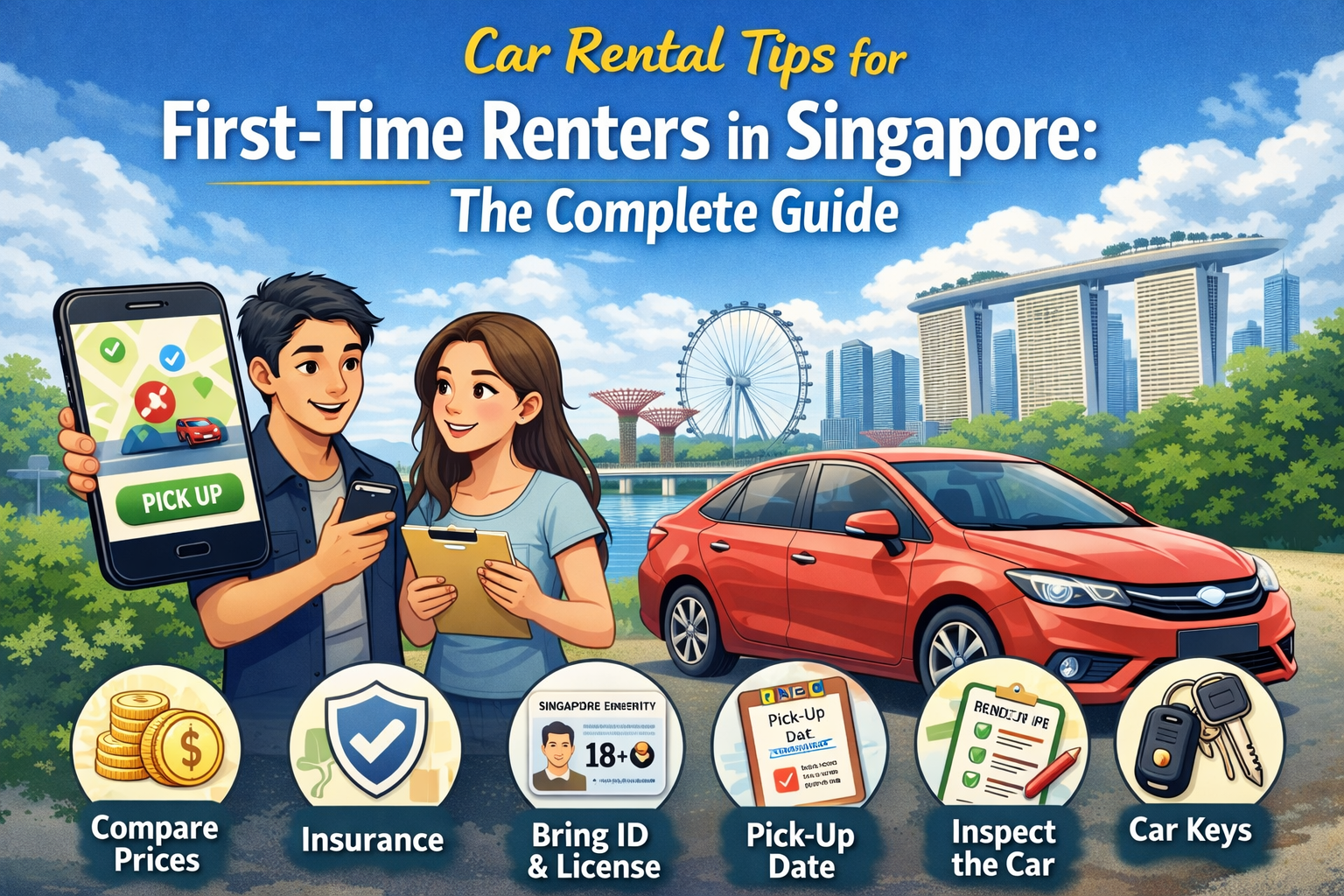
Renting a car in Singapore for the first time can feel overwhelming. Between understanding deposit requirements, figuring out insurance options, and navigating ERP charges, there's a lot to get right before you even turn the key.
This guide cuts through the confusion. Whether you're a local looking to rent for a weekend getaway, a P-plate driver wondering if you even qualify, or a visitor planning to drive across to Malaysia, we'll cover everything you need to know to rent with confidence—and avoid the costly mistakes that catch first-timers off guard.
Before You Book: Getting the Best Deal
Understanding Rental Types
Car rental in Singapore typically falls into three categories, each with different pricing structures:
- Daily rentals – Best for short trips, weekends, or trying out a vehicle. Expect to pay $60-150/day depending on the car class.
- Weekly rentals – Usually 10-15% cheaper per day than daily rates. Ideal for holidays or when your own car is in the workshop.
- Long-term rentals (monthly) – Significant savings, often 30-40% less per day. Good alternative to car ownership without COE commitment.
How Much Does It Cost to Rent a Car in Singapore?
For budget-conscious renters, compact cars like the Toyota Vios start around $60-80/day. Mid-range sedans (Honda Civic, Toyota Camry) run $80-120/day. SUVs and luxury vehicles can hit $150-300/day or more.
But the sticker price isn't the full picture. Factor in:
- Security deposit (typically $200-500, or a credit card hold)
- Insurance excess reduction (optional, $10-30/day)
- Petrol (you'll return the tank at the same level you received it)
- ERP charges during your rental period
Red Flags to Watch For
Not all rental companies operate the same way. Be cautious of:
- Unusually low prices – Often means hidden fees, poor vehicle condition, or minimal insurance coverage.
- No physical inspection before handover – Reputable companies walk through the car with you.
- Vague insurance terms – If they can't clearly explain what's covered, that's a problem.
- Cash-only deposits with no receipt – Always get documentation.
- Pressure to skip the vehicle condition report – Never skip this step.
Documents You'll Need to Rent a Car in Singapore
For Singapore Licence Holders
The requirements are straightforward:
- Valid Singapore driving licence (Class 3/3A for cars)
- NRIC or valid passport
- Credit card for deposit (some companies accept cash deposits)
- Minimum 2 years holding the licence (varies by company—some require just 1 year)
Can P-Plate Drivers Rent a Car in Singapore?
Yes, P-plate drivers can rent cars in Singapore, but options are more limited. Most mainstream rental companies require at least 1-2 years of driving experience after passing your test. However, some companies do cater to newer drivers—you may face higher deposits or be restricted to certain vehicle categories.
If you're a P-plate driver, call ahead to confirm eligibility rather than assuming. Be upfront about your experience level; hiding it can void your insurance coverage.
For Foreign Visitors
Visitors need:
- Valid foreign driving licence (in English, or with certified translation)
- International Driving Permit (IDP) – Required if your licence isn't in English
- Valid passport
- Credit card (usually mandatory for foreigners)
Licences from most countries are accepted for short-term rentals. If you're staying longer than 12 months, you'll need to convert to a Singapore licence.
Age Requirements
Most rental companies require drivers to be at least 21-23 years old. Some luxury or high-performance vehicles may have a minimum age of 25. Young driver surcharges (under 25) are common—typically $10-20/day extra.
Understanding Insurance Options
Insurance is where first-time renters often get confused—or end up paying for coverage they don't need. Here's what matters:
CDW vs SCDW: What's the Difference?
Collision Damage Waiver (CDW) reduces your liability if the car is damaged. Without it, you're responsible for the full repair cost. With basic CDW, you're typically liable for an excess (deductible) of $2,000-5,000.
Super CDW (SCDW) further reduces or eliminates that excess. You'll pay an extra $15-30/day, but your maximum liability drops to $500 or even zero.
What's Usually NOT Covered
Even with full insurance, these are typically your responsibility:
- Damage to tyres, windscreen, and undercarriage
- Loss of personal belongings in the vehicle
- Traffic fines and ERP charges
- Towing fees if you run out of petrol or lock yourself out
- Damage caused while driving under the influence
- Damage in Malaysia (unless you've purchased the extension)
Is the Extra Insurance Worth It?
For first-time renters or those unfamiliar with Singapore roads, SCDW provides peace of mind. A minor scrape in a carpark can easily cost $500-1,000 to repair. If the daily premium is $20 and you're renting for 3 days, that $60 could save you significant stress.
Experienced drivers comfortable with the excess risk can skip it and save money.
The Vehicle Inspection Checklist
This is the step that protects you from being charged for pre-existing damage. Take it seriously.
What to Photograph (Before Driving Off)
Use your phone to document:
- All four corners of the vehicle (exterior)
- Close-ups of any existing scratches, dents, or chips
- Windscreen condition (chips, cracks)
- Wheels and tyres (including spare)
- Interior condition (seats, dashboard, carpets)
- Fuel gauge and odometer reading
- Boot space and any accessories (jack, warning triangle)
Timestamp these photos or include the vehicle condition report in the frame. This takes 5 minutes and can save you hundreds in disputed damage claims.
Functional Checks
Before leaving the lot, verify:
- Lights (headlights, brake lights, indicators)
- Air conditioning
- Wipers and washer fluid
- Horn
- Brakes feel normal
- No warning lights on dashboard
Report any issues immediately—don't assume you can mention it later.
Singapore-Specific Driving Tips
ERP Charges
Singapore's Electronic Road Pricing (ERP) system automatically charges tolls when you pass through gantries during peak hours. The rental car will have an In-vehicle Unit (IU) with a CashCard.
Important points:
- Check the CashCard has sufficient balance before driving (the IU will beep and display the balance)
- Top up at any 7-Eleven, petrol station, or via the Parking.sg app
- If you pass a gantry without sufficient balance, you'll receive a violation notice—the rental company will pass this charge to you, often with an admin fee
- ERP rates vary by location and time—check the LTA website or OneMotoring app for current rates
Parking in Singapore
HDB carparks: Most now use electronic parking (sensor-based). Ensure your IU CashCard is topped up—charges are deducted automatically.
Shopping malls: Usually gantry-based with the first hour free on weekdays. IU required for exit.
Street parking (coupon zones): Rare now, but some older areas still use paper coupons. The Parking.sg app is your best friend—pay digitally and extend remotely if needed.
Peak hours: Expect full carparks at popular malls on weekends. Budget extra time.
Petrol Policies
Most Singapore rentals operate on a "full-to-full" policy: you receive the car with a full tank and return it full. If you return it less than full, you'll be charged for the missing fuel at above-market rates (often $3-4/litre vs the $2.50-3/litre at pumps).
Pro tip: Fill up at a station close to the return point. Many rental lots are near petrol stations for this reason.
Planning to Cross to Malaysia?
Driving to JB or beyond is popular with Singapore renters, but it requires additional preparation.
Tell Your Rental Company First
Not all rental agreements allow cross-border travel. Those that do will require:
- Written permission – Usually a letter authorising the vehicle for Malaysia travel
- Insurance extension – Singapore motor insurance doesn't automatically cover Malaysia. You'll need a separate policy, typically $15-30/day
- Higher deposit – Some companies increase the deposit for Malaysia trips
Attempting to cross without permission voids your insurance and violates your rental agreement. Don't risk it.
VEP Requirements
All Singapore-registered vehicles entering Malaysia need a Vehicle Entry Permit (VEP). This is a Radio Frequency Identification (RFID) tag registered to the vehicle. As a renter, confirm with the rental company that:
- The vehicle has a valid VEP tag installed
- The VEP account is active and has sufficient balance (or is linked to the company's account)
Without a valid VEP, you may be turned away at the checkpoint or face fines in Malaysia.
IU and Touch 'n Go Considerations
Singapore's IU doesn't work at Malaysian toll booths. You'll need Touch 'n Go or use cash lanes. Some rental cars come with a Touch 'n Go card—ask in advance. Otherwise, you can purchase one at the first R&R stop after crossing.
Returning the Car Without Issues
The Final Inspection
Plan to arrive 15-30 minutes before your return time. This allows for:
- Joint inspection with the rental staff
- Documentation of vehicle condition
- Resolution of any minor issues on the spot
If you return after office hours (for 24-hour drop-off), take timestamped photos of the vehicle condition and fuel gauge. Email these to the rental company immediately as your record.
Fuel Policy Compliance
Fill up before returning. Keep the receipt—if there's any dispute about fuel level, you have proof. Most companies give a small tolerance (e.g., needle slightly below full is acceptable), but don't push it.
Late Return Fees
Returning late can be expensive. Most companies offer a 30-60 minute grace period, after which you'll be charged:
- Hourly overtime rate (often $15-25/hour)
- After 3-4 hours late, a full additional day's rental
If you know you'll be late, call ahead. Many companies are flexible if you communicate in advance.
Getting Your Deposit Back
Cash deposits are typically returned on the spot after a clear inspection. Credit card holds are released within 7-14 business days (depends on your bank, not the rental company).
If there's damage, expect the company to provide a repair quote. You have the right to ask for photos and documentation. Disputes should be raised immediately—don't sign off on the return if you disagree with their assessment.
Frequently Asked Questions
How much does it cost to rent a car in Singapore for a day?
Budget cars start around $60-80/day, mid-range sedans $80-120/day, and SUVs or luxury vehicles $150-300/day. Add $200-500 for the security deposit and budget for petrol and ERP charges.
Can I rent a car in Singapore with a P-plate licence?
Yes, though options are limited. Most companies require 1-2 years of driving experience. P-plate drivers may face higher deposits or vehicle restrictions. Call ahead to confirm eligibility with specific rental companies.
What documents do I need to rent a car in Singapore?
Singapore residents need a valid driving licence, NRIC, and credit card. Foreign visitors need their licence (with IDP if not in English), passport, and credit card.
Do I need a credit card, or can I pay cash?
Most companies accept cash deposits, but credit cards are preferred as they can place a hold instead of taking your funds. Foreign visitors typically must use a credit card.
Can I drive a rental car to Malaysia?
Yes, but you need prior approval from the rental company, an insurance extension covering Malaysia, and the vehicle must have a valid VEP. Additional fees apply. Not all companies allow cross-border travel.
What's the cheapest way to rent a car in Singapore?
Book weekly or monthly for lower daily rates. Choose compact cars over sedans. Avoid airport pickup locations (premium pricing). Book directly with rental companies rather than through aggregators. Return on time and with a full tank to avoid penalty charges.
How long does it take to get my deposit back?
Cash deposits are returned immediately after a clear inspection. Credit card holds are released within 7-14 business days, depending on your bank's processing time.
Ready to Rent?
Renting a car in Singapore doesn't have to be complicated. Armed with the right information—from understanding your insurance options to knowing exactly what to photograph before driving off—you can avoid the pitfalls that frustrate first-time renters.
The key takeaways: document everything, understand what your insurance covers (and what it doesn't), communicate with your rental company about any special requirements like Malaysia travel, and always return the car on time with a full tank.
At FreshCars, we believe in transparent pricing and hassle-free rentals. Whether you're renting for a day trip to the zoo or a month while waiting for your new car, our team is here to make the process smooth from booking to return.
Questions about your first rental? Contact us—we're happy to walk you through the process.